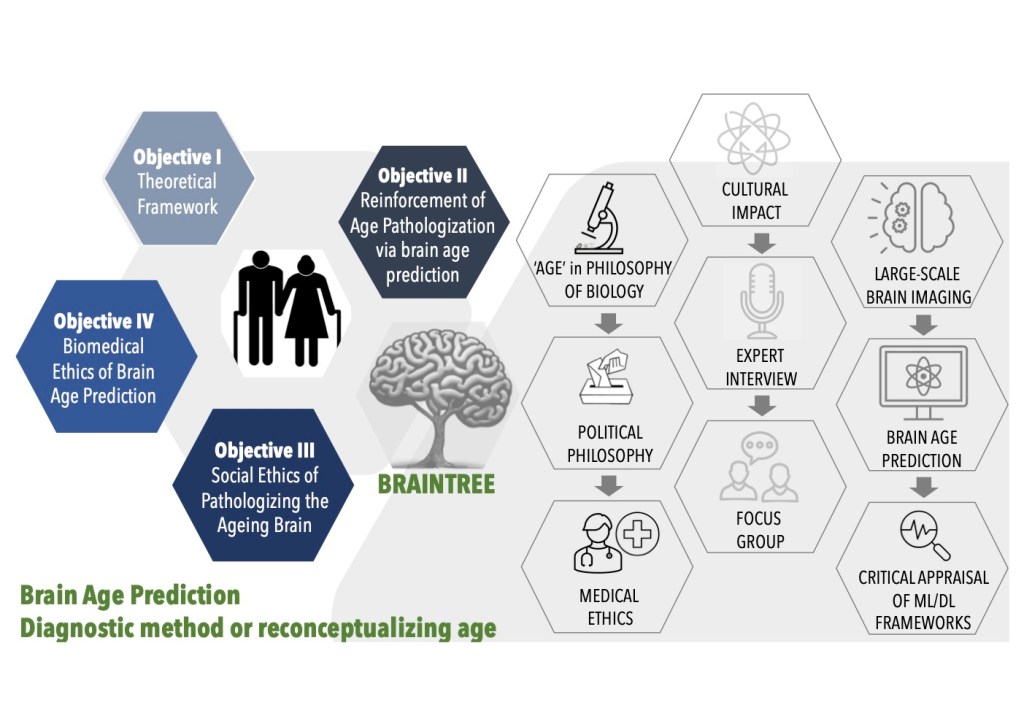
Modern neuroscience methods can be used to assess how old a person’s brain appears to be. If it appears to be older than the person’s passport says, this may be a sign of disease. Such signs can be followed up, and the person’s health can be further investigated. So, brain age estimation is a valuable tool in medicine.
The project will analyse the accuracy, robustness, and reliability of the tools at hand, and how these might be improved. As most tools with potential clinical utility, brain age prediction might pose some risks in the clinic, which will be investigated in the medical ethics part of this project.
At the same time, however, one might think that the word ‚age‘ suddenly comes to refer to a person’s health. Does this make increased age a disease? Should it perhaps even be treated in the same way? We will investigate whether people come to think of old age as a disease, when they learn of brain age prediction. Such a change in people’s beliefs about age will likely have social effects. Age related social rules and structures such as retirement and pension will come under scrutiny. We will investigate, by what means such rules and structures can be justly modified.
Subprojects
The social and ethical dimensions of brain age prediction and similar forms of brain-based prediction can only be addressed in close collaboration between experts from the relevant neurosciences, social science research and ethics.
Neuroscience

The neuroscience subproject empirically differentiates between normal ageing and age-related disorders, examines life factor trajectories in “healthy” and “pathological” ageing and critically evaluates existing machine and deep learning frameworks for brain age prediction.
Social Science

The social science subproject investigates social perceptions of ageing and how they are changing through brain age prediction in expert interviews and focus groups.
Ethics

The ethics subproject provides philosophical groundwork and conceptual background to the other subprojects, integrates their specific contributions and modifies and revises the conceptual framework in the light of empirical findings.
Sponsor
Partners


 Braintree-Project